
Ford Truck Manual Transmissions: A Comprehensive Guide
This guide delves into the world of Ford truck manual transmissions, covering historical models like the NP435 and modern options such as the M5OD-R2.
Ford trucks have a rich history with manual transmissions, offering drivers a connected and engaging driving experience. These transmissions range from the robust, simple designs of the past to the more sophisticated, fully synchronized units found in later models. Understanding these systems is crucial for owners seeking to maintain, repair, or even upgrade their Ford truck;
This guide provides a comprehensive overview, exploring various Ford truck manual transmissions like the M5OD-R1, M5OD-R1HD, and the legendary Granny Gear NP435. We’ll cover identification methods, common issues, maintenance procedures, and even potential swap options, such as utilizing a ZF5 for 4WD upgrades or an M5R2 for 2WD conversions. Whether you’re a seasoned mechanic or a weekend enthusiast, this resource aims to equip you with the knowledge needed to navigate the world of Ford truck manual transmissions.
Historical Overview of Ford Truck Manual Gearboxes
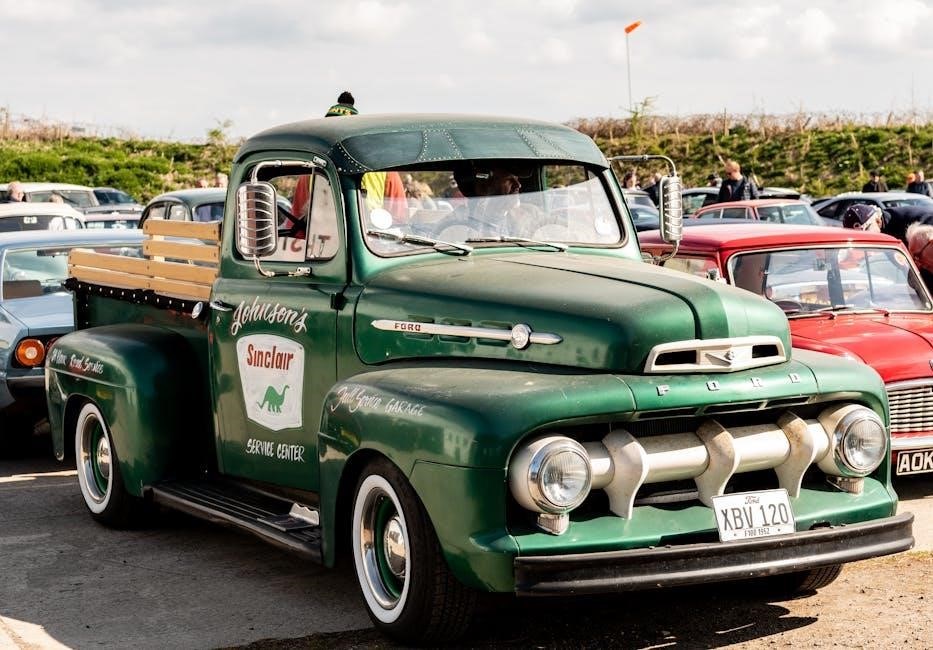
Ford’s journey with manual transmissions in trucks began with durable, albeit simpler, designs. Early models, particularly from the 1969-1979 era, frequently featured the New Process 435 – a “Granny Gear” transmission known for its ruggedness and unsynchronized first gear. This provided exceptional low-end torque for demanding tasks.
Over the years, Ford transitioned through various options like the Borg Warner T-18 and the less-favored SROD 4-speed overdrive. The introduction of the M5OD-R1 in the 1980s marked a shift towards more modern, synchronized transmissions. Later iterations, such as the M5OD-R1HD and M5OD-R2, further refined performance and durability. These evolutions reflect Ford’s commitment to improving both driver experience and the capability of their workhorses.
Common Ford Truck Manual Transmission Models
Several manual transmissions have become synonymous with Ford trucks over the decades. The M5OD-R1, found in Rangers, Broncos II, Explorers, and Aerostars, represents a widely used 5-speed option. For heavier-duty applications, particularly 4.0L V6 Rangers, the M5OD-R1HD offered increased strength.
The M5OD-R2, utilized in Thunderbird Super Coupes and F-150s, provided a more refined experience. Notably, the NP435, often called a “Granny Gear” transmission, remains popular for its robust construction and low-range capability. More recently, the S 542 Heavy-Duty 5-speed, with its fully synchronized gears and aluminum casing, has gained recognition as a strong performer, while the ZF5 is a favored upgrade.
The M5OD-R1 Transmission
The M5OD-R1 is a 5-speed manual transmission commonly found in Ford Rangers, Bronco IIs, Explorers, and Aerostars. It’s known for its relatively simple design and affordability, making it a popular choice for both stock configurations and mild modifications. While generally reliable, it has limitations when subjected to significant power increases or heavy towing.
This transmission offers a straightforward driving experience, though some drivers report a slightly notchy shift feel. It’s crucial to maintain proper fluid levels and inspect for leaks to ensure longevity. The M5OD-R1 represents a solid, cost-effective manual transmission option for many Ford truck applications, particularly those prioritizing everyday usability.
The M5OD-R1HD Transmission
The M5OD-R1HD is a heavy-duty variant of the standard M5OD-R1, specifically designed for the 4.0L V6 engine in the Ford Ranger. This upgraded version features stronger internal components, including gears and shafts, to handle the increased torque output of the larger engine. It’s a significant improvement over the base M5OD-R1 for those seeking enhanced durability and reliability.
The “HD” designation signifies its capability to withstand more demanding conditions, making it suitable for light to moderate towing and off-road use. Identifying an M5OD-R1HD is crucial when sourcing parts or performing repairs, as components are not always interchangeable with the standard R1 model.
The M5OD-R2 Transmission
The M5OD-R2 represents a later-generation Ford manual transmission, finding application in vehicles like the Thunderbird Super Coupe and select Ford F-150 and Bronco models. This five-speed gearbox is known for its smoother shifting characteristics and more modern design compared to earlier Ford manual options. It offers a refined driving experience, particularly noticeable in everyday commuting and highway cruising.
The M5OD-R2 is often sought after for swap projects, especially in 2WD applications, due to its relative ease of installation and improved performance. However, it’s essential to verify compatibility with the specific vehicle and engine combination before undertaking such a modification.
Identifying Your Ford Truck’s Manual Transmission
Accurately identifying your Ford truck’s manual transmission is crucial for maintenance, repairs, and parts sourcing. Several avenues exist for uncovering this information. Start by checking original vehicle documentation, such as the window sticker, build sheet, or a Vehicle Identification (VIN) decode letter. These resources often explicitly state the installed transmission model.
Decoding the VIN itself can also reveal transmission details, though this often requires specialized tools or online databases. Knowing the exact transmission model ensures you obtain the correct fluids, parts, and service procedures, preventing costly mistakes and maintaining optimal performance. Careful identification is the first step towards successful ownership.
Locating Transmission Information on Vehicle Documentation
Essential transmission details are frequently recorded on original vehicle paperwork; The window sticker, affixed during the initial sale, often lists the transmission type as part of the vehicle’s specifications. Similarly, the build sheet – a detailed record of how the truck was assembled – will explicitly state the installed manual transmission model.
A Vehicle Identification (VIN) decode letter, obtainable from Ford or through online services, provides a comprehensive breakdown of the vehicle’s features, including the transmission. Carefully examine these documents; they represent the most reliable source of information regarding your truck’s original configuration, aiding in accurate maintenance and repair.
Using the Vehicle Identification Number (VIN) for Decoding
The Vehicle Identification Number (VIN) is a unique code that holds crucial information about your Ford truck, including its original transmission. Several online VIN decoder tools are available, often free of charge, allowing you to input the 17-digit VIN and receive a detailed report.
This report will reveal the transmission code, identifying the specific manual transmission installed at the factory. Be aware that some decoders may require a paid subscription for complete information. Accurate VIN decoding is vital for confirming the transmission model, especially when researching parts or planning a swap, ensuring compatibility and proper fitment.
The Granny Gear Transmission (NP435)
The NP435 is a legendary, robust 4-speed manual transmission renowned for its durability and simplicity, commonly found in Ford trucks from 1969 to 1979. Its defining feature is the exceptionally low “granny gear” first speed, providing immense torque multiplication for challenging terrain or heavy loads.
Notably, the first gear is unsynchronized, requiring a practiced double-clutching technique for smooth engagement. Despite this, the NP435’s strength and reliability have made it a favorite among enthusiasts, often sought after for restoration projects or demanding applications. It’s a testament to Ford’s commitment to building tough, dependable trucks.

Heavy-Duty Truck Transmission Maintenance
Heavy- and medium-duty Ford truck transmissions endure significant stress, demanding a proactive maintenance approach to ensure longevity and minimize downtime. Regular inspections are crucial, focusing on fluid levels, leaks, and the overall condition of the transmission housing.
Preventive measures, such as timely fluid changes using the correct specification, are paramount. Ignoring maintenance can lead to costly failures and extended periods of vehicle unavailability. Addressing minor issues promptly prevents them from escalating into major repairs, safeguarding your investment and keeping your truck operational. Consistent care is key to reliable performance.
Preventive Maintenance for Ford Truck Manual Transmissions
Establishing a routine preventive maintenance schedule is vital for extending the life of your Ford truck’s manual transmission. This includes regularly checking and topping off transmission fluid to the correct level, ensuring optimal lubrication and cooling. Inspect the shift linkage for wear and proper adjustment, guaranteeing smooth and precise gear changes.

Furthermore, periodically examine the transmission housing for any signs of leaks or damage. Addressing these issues early prevents more significant problems down the road. Consistent attention to these details minimizes the risk of costly repairs and maximizes the reliability of your Ford truck’s manual gearbox.
Common Issues with Ford Truck Manual Transmissions
Several common problems can affect Ford truck manual transmissions, impacting their performance and reliability. Synchronization issues often manifest as difficulty engaging certain gears, particularly when shifting quickly. Gear grinding, a noticeable and unpleasant sound, frequently accompanies these synchronization problems, indicating worn synchronizers.
Difficulty shifting, even without grinding, can stem from worn shift linkage, low transmission fluid, or internal damage. Ignoring these symptoms can lead to more extensive and expensive repairs. Regular inspection and prompt attention to these issues are crucial for maintaining a smoothly operating manual transmission in your Ford truck.
Synchronization Problems
Synchronization issues within a Ford truck’s manual transmission typically present as difficulty smoothly engaging specific gears, most noticeably during quicker shifts. This occurs because the synchronizers, responsible for matching the speeds of the gears before engagement, are worn or damaged. The result is a clash between the gears, leading to a grinding noise or a reluctant shift.

Often, this problem is more pronounced in certain gears than others, depending on usage patterns. Ignoring synchronization problems can accelerate wear on other transmission components. Addressing these issues promptly, through inspection and potential replacement of synchronizers, is vital for restoring smooth and reliable shifting performance.
Gear Grinding and Difficulty Shifting
Experiencing gear grinding and difficulty shifting in your Ford truck’s manual transmission signals underlying mechanical issues. This can manifest as a harsh, grating sound when attempting to select a gear, or a complete inability to engage certain gears altogether. Several factors contribute to this, including worn synchronizers, damaged gear teeth, or low/contaminated transmission fluid.
Often, the problem worsens with temperature changes or under load. Ignoring these symptoms can lead to further damage, potentially requiring a complete transmission rebuild. A thorough inspection of internal components, fluid levels, and linkage adjustments is crucial for diagnosing and resolving these shifting challenges.
Transmission Fluid Types and Recommendations
Selecting the correct transmission fluid is paramount for the longevity and smooth operation of your Ford truck’s manual gearbox. Historically, many Ford manual transmissions utilized a specific type of gear oil, often differing based on the model and year. Modern transmissions, like the M5OD-R2, generally require a fully synthetic 75W-90 gear oil meeting Ford specification M2C501-A.
Using the incorrect fluid can lead to synchronization issues, accelerated wear, and ultimately, transmission failure. Always consult your owner’s manual or a trusted parts supplier to confirm the appropriate fluid type for your specific transmission. Regular fluid changes, typically every 30,000-60,000 miles, are also vital for maintaining optimal performance.
The S 542 Heavy-Duty 5-Speed Transmission
The S 542 represents a robust and fully synchronized 5-speed manual transmission, often sought after for its durability and performance enhancements. Distinguished by its aluminum case and extension housing, the S 542 features an integral bell housing, simplifying installation in compatible Ford trucks. This design contributes to its lighter weight compared to some older, heavier-duty options.
The S 542’s fully synchronized gears provide smoother and quieter shifting, improving the overall driving experience. It’s a popular upgrade choice for those seeking a more modern and refined manual transmission feel in their Ford truck, offering a balance of strength and usability.
Ford Truck Manual Transmission Swaps
Manual transmission swaps in Ford trucks are a popular modification, offering drivers greater control and a more engaging driving experience. For 2WD OBS (Old Body Style) Ford trucks, the M5R2 transmission emerges as a primary manual swap option, providing a relatively straightforward installation process. However, owners desiring a more robust solution often consider upgrades.

When a 4WD system is involved, the ZF5 transmission frequently becomes the preferred choice. It’s recognized as a significant upgrade, offering increased strength and reliability compared to other options. Careful consideration of driveline angles, crossmembers, and shifter linkages is crucial for a successful swap, ensuring proper function and longevity.
Considerations for 2WD Manual Swaps (M5R2)
When undertaking a 2WD manual swap utilizing the M5R2 transmission, several factors demand careful attention. This transmission is frequently chosen for its relative simplicity and cost-effectiveness in rear-wheel-drive applications. However, compatibility with the existing driveshaft and rear differential is paramount, potentially requiring modifications or replacements to ensure proper fitment and function.
Furthermore, the pedal assembly and shifter linkage will necessitate adjustments or complete replacements to accommodate the manual operation. Thorough research into required components, including the clutch master cylinder and slave cylinder, is essential for a smooth and successful conversion. Proper alignment and secure mounting are critical for long-term reliability.
ZF5 Transmission as a 4WD Upgrade Option
For 4WD Ford truck owners seeking a robust manual transmission upgrade, the ZF5 stands out as a highly regarded choice. Known for its durability and smooth shifting, it often replaces weaker factory options. However, a ZF5 swap isn’t a direct bolt-in; it requires a crossmember modification or replacement to accommodate its larger size and different mounting points.
Additionally, the input shaft length and spline count must match the transfer case, potentially necessitating a transfer case adapter or a different transfer case altogether. Clutch compatibility and proper speedometer recalibration are also crucial considerations. Careful planning and sourcing the correct components are vital for a successful and reliable ZF5 conversion in a 4WD application.
Ford Automatic Transmissions (Brief Mention for Context)
While this guide focuses on manual transmissions, acknowledging Ford’s automatic offerings provides valuable context. Historically, the C4 and C6 automatics were workhorses, renowned for their simplicity and durability, often found in older Ford trucks; The AOD followed, introducing overdrive for improved fuel economy.
More recently, Ford transitioned to advanced automatics like the 6R80, 6R140, and 10R80, featuring six, eight, and ten speeds respectively. These modern transmissions offer enhanced efficiency and performance. Understanding the evolution of Ford’s automatic transmissions highlights the shift towards greater sophistication and efficiency, contrasting with the direct mechanical feel of manual gearboxes.
C4/C6 Automatic Transmissions
The C4 and C6 automatic transmissions represent a cornerstone of Ford’s automatic transmission history, particularly prevalent in trucks and performance vehicles from the 1960s through the 1980s. The C4, a three-speed automatic, was lighter and often found in smaller trucks and cars, while the C6, also a three-speed, was built heavier-duty for larger trucks and high-performance applications.

Both were known for their robust construction and relative simplicity, making them reliable and easily serviceable. They lacked the fuel efficiency of later overdrive transmissions, but their durability made them a favorite for towing and demanding work. These transmissions remain popular for restorations and classic Ford truck builds.
AOD Automatic Transmission
The AOD (Automatic Overdrive) transmission emerged as a significant advancement in Ford’s automatic transmission lineup during the 1980s. Unlike the earlier C4 and C6 models, the AOD incorporated a fourth gear – an overdrive – improving fuel economy, especially at highway speeds. This made it a popular choice for Ford trucks and cars seeking a balance between performance and efficiency.
However, the AOD wasn’t without its weaknesses. Early versions were prone to overheating and failure under heavy loads or aggressive driving. Later revisions addressed some of these issues, but the AOD never quite achieved the legendary durability of the C6. Despite this, it remains a viable option for classic Ford restorations and modifications.
6R80/6R140/10R80 Modern Automatic Transmissions
Ford’s modern automatic transmissions – the 6R80, 6R140, and 10R80 – represent a leap forward in technology and capability. These transmissions boast six, eight, and ten forward gears respectively, maximizing fuel efficiency and providing smoother acceleration. The 6R80 is commonly found in lighter-duty trucks and SUVs, while the robust 6R140 handles the demands of heavier-duty applications like Super Duty pickups.
The 10R80, a newer addition, offers even greater efficiency and refinement. These transmissions utilize advanced features like electronic control, adaptive learning, and torque converter lock-up strategies. While complex, they deliver a superior driving experience and contribute to improved overall vehicle performance.
Resources for Ford Truck Manual Transmission Information
Numerous online and offline resources cater to Ford truck manual transmission enthusiasts and mechanics. Automotive forums dedicated to Ford trucks, such as those found on dedicated truck websites, are invaluable for troubleshooting, identifying parts, and sharing experiences. Matt Nelson, an automotive journalist with extensive dealership experience, provides insightful articles and guidance.
Online parts retailers often feature detailed diagrams and compatibility information. Vehicle Identification Number (VIN) decoding services can pinpoint the original transmission installed in your truck. Repair manuals, both physical and digital, offer detailed procedures and specifications. Don’t underestimate the value of experienced Ford mechanics and transmission specialists for complex issues.
Finding Replacement Parts for Ford Truck Manual Transmissions
Sourcing replacement parts for Ford truck manual transmissions requires a strategic approach. Online retailers specializing in Ford truck parts offer a vast selection, often with detailed compatibility charts. Local auto parts stores can source common components, but may have limited availability for older or rarer transmissions. Salvage yards are excellent resources for used parts, offering cost-effective solutions, but condition varies.
When ordering, always verify the part number and compatibility with your specific transmission model and truck year. Forums and online communities can provide valuable insights into reliable suppliers and potential pitfalls. Consider rebuilding kits for comprehensive repairs, and don’t hesitate to consult with a transmission specialist for guidance.
Professional Assistance and Repair Services
When facing complex issues with your Ford truck’s manual transmission, seeking professional assistance is often the most prudent course of action. Qualified transmission shops possess the expertise, specialized tools, and diagnostic equipment necessary for accurate assessment and repair. They can handle everything from simple clutch replacements to complete transmission rebuilds.
Look for shops with experienced technicians specializing in Ford transmissions and positive customer reviews. Obtain detailed quotes outlining the scope of work and associated costs before authorizing any repairs. A reputable shop will thoroughly explain the problem, proposed solutions, and warranty coverage. Don’t hesitate to ask questions and ensure you’re comfortable with the process.