
Edexcel GCSE Maths Revision Guide: A Comprehensive Plan
Prepare effectively for your 2026/2027 Edexcel GCSE Maths exams! Utilize resources like Pearson REVISE‚ Collins‚ and CGP guides‚
supplemented by online quizzes and videos for thorough revision.
I. Number
Mastering number skills is foundational for GCSE Maths success. This section focuses on building a robust understanding of various number types – integers‚ decimals‚ fractions‚ and powers – crucial for tackling complex problems.
Place value and rounding are essential for accurate calculations and estimations. Practice identifying the value of digits and applying rounding rules to appropriate degrees of accuracy.
Operations with numbers – addition‚ subtraction‚ multiplication‚ and division – form the core of mathematical manipulation. Ensure fluency in both written and mental methods‚ including working with negative numbers and order of operations (BODMAS/BIDMAS).
Resources like the CGP Revision Guide offer concise explanations and step-by-step examples‚ presented in a student-friendly style. Focus on applying these concepts to problem-solving scenarios‚ utilizing online quizzes and videos from Pearson REVISE and Collins for reinforcement. A strong grasp of number fundamentals will significantly boost your confidence and performance.
A. Types of Numbers
A solid understanding of different number types is vital for Edexcel GCSE Maths. Begin with integers – whole numbers‚ both positive and negative – and their properties. Explore rational numbers‚ which can be expressed as fractions‚ and irrational numbers‚ like pi (π) and the square root of 2‚ which have non-terminating‚ non-repeating decimal representations.
Real numbers encompass all rational and irrational numbers. Additionally‚ familiarize yourself with prime numbers (divisible only by 1 and themselves) and composite numbers (having more than two factors).
Understanding these classifications is crucial for simplifying expressions and solving equations. Revision guides‚ such as those from CGP‚ clearly define each type with examples. Supplement this with online resources offering interactive quizzes to test your knowledge. Mastering number types provides a strong foundation for more advanced mathematical concepts.
B. Place Value and Rounding
A firm grasp of place value is fundamental to accurate calculations in Edexcel GCSE Maths. Understand how the position of a digit determines its value (ones‚ tens‚ hundreds‚ etc.)‚ extending to decimals and negative numbers. This knowledge is essential for both addition‚ subtraction‚ and interpreting larger numerical values.

Rounding skills are equally important‚ particularly when dealing with estimations and real-world data. Learn to round to the nearest ten‚ hundred‚ thousand‚ and decimal place‚ understanding the rules for rounding up or down.
Revision guides from Collins and Pearson REVISE provide clear explanations and practice questions on place value and rounding. Utilize online quizzes to reinforce your understanding and build confidence. Accurate rounding prevents errors and demonstrates a practical application of mathematical principles.
C. Operations with Numbers (Addition‚ Subtraction‚ Multiplication‚ Division)
Mastering the four basic operations – addition‚ subtraction‚ multiplication‚ and division – is crucial for success in Edexcel GCSE Maths. Ensure fluency with both whole numbers and decimals‚ understanding the order of operations (BIDMAS/BODMAS) to avoid common errors. Practice applying these operations to solve various problems‚ including those involving negative numbers and fractions.
Revision guides‚ such as those from CGP Books‚ offer step-by-step examples and plenty of practice questions to solidify your understanding. Pay close attention to techniques for efficient calculation‚ like column addition and long division.
Online resources and quizzes can help identify areas where you need further practice. A strong foundation in these operations is essential for tackling more complex mathematical concepts later in the course. Don’t underestimate the importance of regular practice!
II. Algebra
Algebra forms a significant portion of the Edexcel GCSE Maths syllabus‚ demanding a solid grasp of fundamental concepts. This includes simplifying expressions by collecting like terms‚ expanding brackets‚ and factorising. Developing proficiency in solving equations – both linear and quadratic – is paramount‚ utilizing techniques like isolating the variable and applying the quadratic formula.
Understanding inequalities and representing solutions on a number line is also vital. Furthermore‚ explore sequences‚ recognizing arithmetic and geometric progressions‚ and learning to determine their nth term.
Revision guides from Pearson REVISE and Collins provide clear explanations and ample practice exercises. Supplement your learning with online resources offering interactive quizzes and video tutorials to reinforce your understanding of these core algebraic principles. Consistent practice is key to building confidence and achieving success.
A. Simplifying Expressions
Mastering the simplification of algebraic expressions is foundational for success in Edexcel GCSE Maths. This involves combining ‘like terms’ – those with the same variable and power – to reduce expressions to their simplest form. Expanding brackets using the distributive property is crucial; remember to multiply the term outside the bracket by each term inside.
Factorising‚ the reverse of expanding‚ requires identifying common factors within an expression and expressing it as a product. Pay close attention to negative signs and ensure all terms are correctly distributed.
Resources like CGP Books emphasize a clear‚ step-by-step approach‚ while online quizzes offer immediate feedback on your progress. Practice identifying and applying these techniques consistently to build fluency and avoid common errors. A strong understanding here will significantly aid in solving equations later on.
B. Solving Equations (Linear and Quadratic)
Successfully solving equations is a core skill for the Edexcel GCSE Maths exam. Linear equations‚ involving a single variable to the power of one‚ are solved by isolating the variable using inverse operations – addition/subtraction and multiplication/division. Maintaining balance on both sides of the equation is paramount.
Quadratic equations‚ featuring a variable raised to the power of two‚ require more sophisticated techniques. Factorising (if possible) is often the quickest method‚ setting each factor equal to zero to find the solutions. Alternatively‚ the quadratic formula provides a guaranteed solution‚ even for equations that don’t factorise easily.
Revision guides from Pearson REVISE and Collins offer detailed explanations and worked examples. Practice is key; utilize online resources and past papers to build confidence and speed. Remember to check your solutions by substituting them back into the original equation.
C. Inequalities
Mastering inequalities is crucial for achieving success in the Edexcel GCSE Maths exam. Unlike equations‚ inequalities use symbols like <‚ >‚ ≤‚ or ≥ to show the relationship between expressions. Solving them involves similar principles to solving equations – isolating the variable – but with a vital difference: multiplying or dividing by a negative number reverses the inequality sign.
Representing inequalities on a number line is a key skill. Use open circles for < or > (excluding the endpoint) and closed circles for ≤ or ≥ (including the endpoint). Understanding the concept of a range of possible values is essential.
Revision guides‚ such as those from CGP Books‚ provide clear explanations and step-by-step examples. Practice solving various inequalities and interpreting their graphical representations. Online quizzes and past papers will help solidify your understanding and build exam confidence.
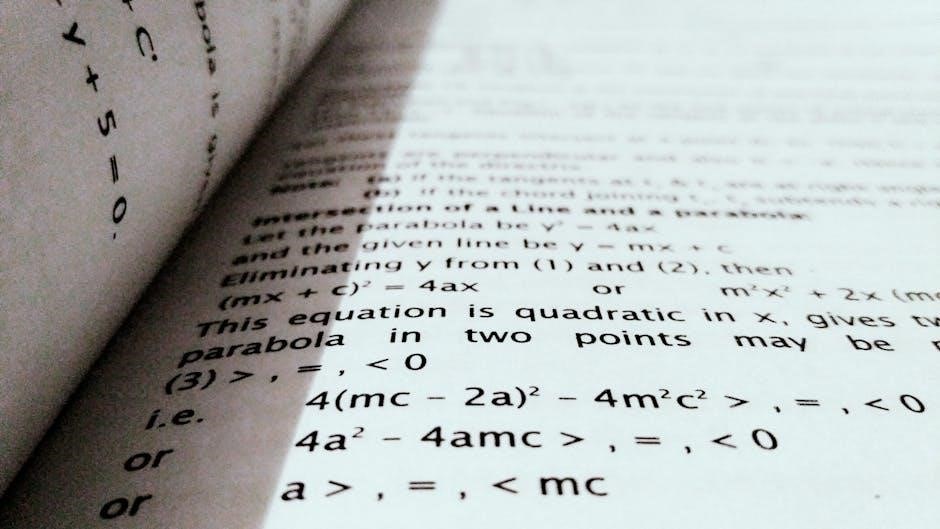
D. Sequences (Arithmetic and Geometric)
Sequences are ordered lists of numbers‚ and understanding them is a key component of the Edexcel GCSE Maths syllabus. Two primary types are arithmetic and geometric sequences. Arithmetic sequences increase or decrease by a constant difference (the common difference)‚ while geometric sequences increase or decrease by a constant factor (the common ratio).
Finding the nth term of a sequence is vital. For arithmetic sequences‚ the formula is a + (n-1)d (where ‘a’ is the first term and ‘d’ is the common difference). Geometric sequences use ar(n-1) (where ‘r’ is the common ratio).
Revision guides‚ like those from Collins and Pearson REVISE‚ offer detailed explanations and practice questions. Mastering these concepts requires consistent practice with identifying patterns‚ calculating terms‚ and applying the correct formulas. Utilize online resources for additional support and exam-style questions.
III. Ratio‚ Proportion and Rates of Change
Ratio‚ proportion‚ and rates of change are interconnected concepts frequently tested in the Edexcel GCSE Maths exam. Understanding ratios involves comparing quantities‚ often simplified to their lowest terms. Proportion explores relationships where quantities increase or decrease at a constant rate – both direct and inverse proportion are crucial.
Direct proportion means quantities increase together‚ while inverse proportion means one quantity increases as the other decreases. Calculating percentage change is also essential‚ requiring understanding of fractions and decimals.
Revision guides‚ such as those from CGP and Pearson REVISE‚ provide clear explanations and worked examples. Practice applying these concepts to real-world problems‚ like scaling recipes or converting currencies. Online quizzes and videos can reinforce your understanding and build confidence for the exam.
A. Ratios and Proportions
Mastering ratios and proportions is fundamental for Edexcel GCSE Maths success. A ratio compares quantities – for example‚ 2:3 represents a relationship where one quantity is twice the size of the other. Simplifying ratios to their lowest terms is a key skill. Proportions build on this‚ exploring equivalent ratios and solving problems involving proportional reasoning.
Understanding direct proportion – where quantities increase together – and inverse proportion – where one quantity increases as the other decreases – is vital. Practice identifying proportional relationships from tables and graphs.
Revision guides like Collins Edexcel GCSE 9-1 Maths offer step-by-step examples. Utilize online resources for additional practice‚ focusing on word problems that require you to set up and solve proportional equations. Remember to always check your answers for reasonableness!
B. Direct and Inverse Proportion
Direct and inverse proportion are crucial concepts within Edexcel GCSE Maths. Direct proportion means variables change at a constant rate – as one increases‚ the other increases proportionally. This is represented by equations like y = kx‚ where ‘k’ is the constant of proportionality. Identifying this relationship from tables and graphs is key.
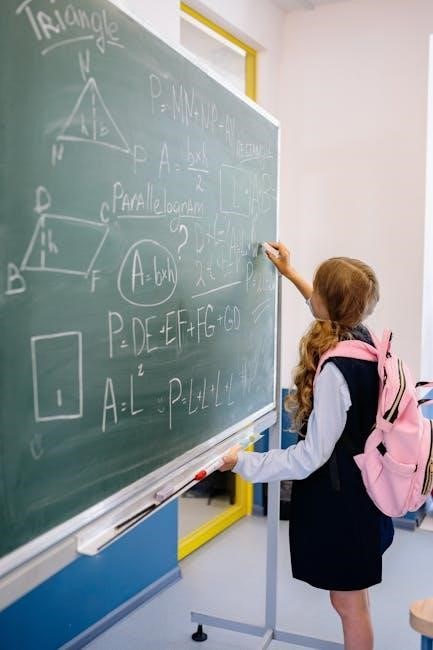
Inverse proportion‚ conversely‚ shows variables changing in opposite directions. As one increases‚ the other decreases‚ maintaining a constant product (y = k/x); Understanding how to determine ‘k’ in both scenarios is essential for problem-solving.
CGP Books’ GCSE Maths Revision Guide provides clear explanations and examples. Practice recognizing these relationships in real-world contexts‚ such as speed‚ distance‚ and time. Focus on setting up equations and solving for unknown variables. Online quizzes can reinforce your understanding and build confidence.
C. Percentage Change
Mastering percentage change is vital for Edexcel GCSE Maths success. This encompasses calculating percentage increase and decrease‚ often applied to prices‚ quantities‚ or populations. The core formula is: [(New Value ― Original Value) / Original Value] x 100.
Understanding the context is crucial. A percentage increase signifies a positive change‚ while a decrease indicates a negative one. Be mindful of identifying the ‘original value’ correctly – it’s the starting point for the calculation.
Revision guides‚ like those from Pearson REVISE and Collins‚ offer step-by-step examples and practice questions. Pay attention to worded problems‚ translating them into numerical expressions. Utilize online resources for additional practice and to check your answers. Successfully applying this skill builds a strong foundation for more complex financial maths topics.
IV. Geometry and Measures
Geometry and Measures form a significant portion of the Edexcel GCSE Maths exam. Key areas include angles within shapes (triangles‚ quadrilaterals‚ polygons)‚ and understanding geometric proofs. Mastering these concepts is essential for problem-solving.
Area and Volume calculations are crucial. Know the formulas for common 2D shapes (rectangles‚ triangles‚ circles) and 3D solids (cubes‚ cuboids‚ cylinders‚ prisms). Pay close attention to units – ensure consistency throughout your calculations.
Pythagoras’ Theorem (a² + b² = c²) and Trigonometry (SOH CAH TOA) are fundamental. Practice applying these to find missing sides and angles in right-angled triangles. Revision guides from CGP‚ Collins‚ and Pearson REVISE provide clear explanations and worked examples. Supplement your learning with online videos and quizzes to solidify your understanding and build confidence.
A. Angles and Shapes
A strong grasp of angles and shapes is vital for Edexcel GCSE Maths success. Begin with identifying different types of angles – acute‚ obtuse‚ right‚ and reflex – and their properties. Understand angle sums within triangles (180°) and quadrilaterals (360°).
Polygon properties are key. Learn the names and characteristics of regular and irregular polygons‚ including the number of sides and angles. Explore concepts like interior and exterior angles‚ and their relationships.
Geometric proofs and reasoning are increasingly important. Practice proving geometric statements using logical arguments and known angle rules. Utilize revision guides like those from CGP and Collins‚ which offer step-by-step explanations and diagrams. Reinforce your learning with online resources‚ focusing on practice questions and visual aids to master these foundational geometric concepts.
B. Area and Volume
Mastering area and volume calculations is crucial for Edexcel GCSE Maths. Begin with 2D shapes: rectangles (length x width)‚ triangles (1/2 x base x height)‚ parallelograms‚ and trapeziums. Understand the area of circles (πr²) and composite shapes by dividing them into simpler components.
Extend this knowledge to 3D shapes. Calculate the volume of cuboids (length x width x height)‚ prisms (area of cross-section x length)‚ cylinders (πr²h)‚ and pyramids/cones (1/3 x base area x height). Pay close attention to units – ensure consistency (cm²‚ cm³‚ etc.).
Revision guides from Pearson REVISE‚ Collins‚ and CGP provide clear formulas and worked examples. Supplement this with online quizzes and videos to practice applying these concepts to various problems. Focus on problem-solving skills and understanding why the formulas work‚ not just memorizing them.
C. Pythagoras’ Theorem and Trigonometry
Pythagoras’ Theorem (a² + b² = c²) is fundamental for finding missing sides in right-angled triangles. Ensure you identify the hypotenuse (the longest side) correctly. Practice applying this theorem to various geometric problems‚ including those involving real-world scenarios.
Trigonometry (SOH CAH TOA) builds upon this. Understand the sine‚ cosine‚ and tangent ratios and how to use them to find angles and sides in right-angled triangles. Be comfortable working with inverse trigonometric functions (sin⁻¹‚ cos⁻¹‚ tan⁻¹).
Revision guides like those from CGP Books offer concise explanations and step-by-step examples. Utilize online resources – videos and quizzes – to reinforce your understanding and practice applying these concepts. Mastering these tools is vital for higher-tier Edexcel GCSE Maths questions.
V. Probability and Statistics
Probability focuses on the likelihood of events. Understand basic probability calculations (number of favorable outcomes / total possible outcomes). Explore concepts like mutually exclusive events and independent events‚ and how to calculate their probabilities; Practice using probability trees for more complex scenarios.
Statistics involves collecting‚ organizing‚ and interpreting data. Master data representation techniques like histograms‚ bar charts‚ pie charts‚ and scatter graphs. Learn to calculate measures of central tendency – mean‚ median‚ and mode – and understand the range as a measure of spread.
Revision guides‚ such as those by Collins‚ provide clear explanations and practice questions. Supplement your learning with online quizzes and videos to solidify your understanding. A strong grasp of these concepts is crucial for success in the Edexcel GCSE Maths exam.
A. Basic Probability
Probability is the measure of how likely an event is to occur. It’s expressed as a fraction‚ decimal‚ or percentage‚ always between 0 and 1 (or 0% and 100%). The fundamental formula is: Probability = (Number of favorable outcomes) / (Total number of possible outcomes).
Understand key terms: Sample space (all possible outcomes)‚ event (a specific outcome). Practice calculating probabilities of single events‚ like rolling a specific number on a die or drawing a particular card from a deck. Explore mutually exclusive events – events that cannot happen at the same time – and how to calculate the probability of either one occurring.
Revision resources‚ including CGP books‚ emphasize a clear‚ step-by-step approach. Utilize online quizzes to test your understanding and identify areas for improvement. Mastering basic probability is foundational for more complex statistical concepts.
B. Data Representation (Charts and Graphs)
Effectively presenting data is crucial for analysis and interpretation. Edexcel GCSE Maths requires proficiency in various charts and graphs‚ including bar charts‚ line graphs‚ pie charts‚ scatter graphs‚ and histograms. Understand the strengths and weaknesses of each type and when to use them appropriately.
Focus on interpreting data: extracting information‚ identifying trends‚ and drawing conclusions. Practice constructing these graphs accurately‚ paying attention to scales‚ labels‚ and titles. Scatter graphs are particularly important for identifying correlations between two variables. Histograms are used for grouped continuous data.
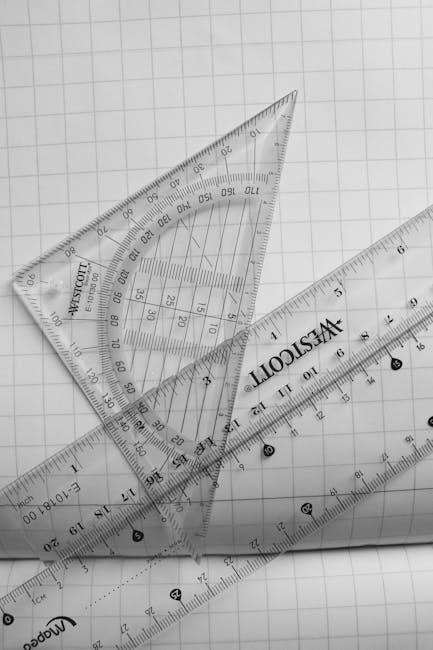
Revision guides‚ like those from Collins and Pearson REVISE‚ provide clear examples and practice questions. Online resources offer interactive exercises to solidify your understanding. Mastering data representation skills is vital for success in the statistics section of the exam.
C. Averages and Range
Understanding averages and the range is fundamental to statistical analysis in Edexcel GCSE Maths. You’ll need to confidently calculate the mean‚ median‚ and mode from both raw data and frequency tables. Recognize when each average is most appropriate – the mean is sensitive to outliers‚ while the median provides a central value unaffected by extreme scores.
The range‚ calculated as the difference between the highest and lowest values‚ indicates the spread of the data. Practice identifying and calculating these measures accurately. Revision guides‚ such as those from CGP Books‚ offer step-by-step examples and practice questions to build your skills.
Online quizzes and videos can further reinforce your understanding. Be prepared to apply these concepts to real-world problems and interpret statistical data presented in various formats. Mastering averages and range is essential for achieving a strong grade.
VI. Exam Preparation & Resources
Effective exam preparation is crucial for success in Edexcel GCSE Maths. Implement robust revision techniques‚ such as spaced repetition and active recall‚ to solidify your understanding. Regularly tackling practice papers and past papers is paramount; these familiarize you with the exam format‚ question types‚ and time constraints.
Numerous online resources are available‚ including videos and interactive quizzes‚ to supplement your learning. Pearson REVISE‚ Collins‚ and CGP offer comprehensive revision guides specifically tailored to the Edexcel syllabus‚ providing concise explanations and targeted practice.
Utilize these resources strategically to identify your weaknesses and focus your revision efforts. Remember‚ consistent practice and a well-structured revision plan are key to maximizing your potential and achieving a strong result in your GCSE Maths exam.
A. Revision Techniques
Maximize your Edexcel GCSE Maths revision with proven techniques. Spaced repetition – reviewing material at increasing intervals – strengthens memory retention. Active recall‚ like practice questions without notes‚ forces your brain to retrieve information‚ boosting understanding.
Employ the Pomodoro Technique: focused 25-minute study sessions followed by short breaks. Create flashcards for key formulas and definitions. Teach concepts to others; explaining solidifies your own grasp. Regularly review past papers‚ identifying weak areas for targeted practice.
Don’t just passively read; actively engage with the material. Work through examples step-by-step‚ and create mind maps to visualize connections between topics. Prioritize consistent‚ short bursts of revision over infrequent‚ lengthy sessions. A structured approach is vital for success.
B. Practice Papers and Past Papers
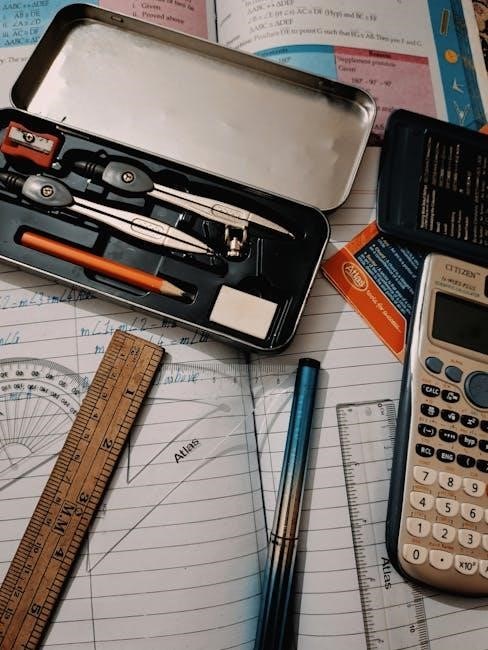
Mastering Edexcel GCSE Maths requires extensive practice with past and practice papers. These resources familiarize you with the exam format‚ question styles‚ and time constraints. Regularly attempting papers builds speed and accuracy‚ crucial for exam success.
Focus on analyzing your mistakes; identify recurring errors and address the underlying concepts. Utilize official Edexcel past papers available on their website or through revision guides like Pearson REVISE and Collins. Supplement these with practice papers from CGP Books‚ offering varied question types.
Simulate exam conditions – timed papers‚ no notes – to build confidence and reduce anxiety. Review mark schemes to understand how examiners award marks. Prioritize papers covering topics you find challenging. Consistent practice is the cornerstone of achieving a strong grade.
C. Online Revision Resources (Videos‚ Quizzes)
Enhance your Edexcel GCSE Maths revision with a wealth of online resources. Platforms offer engaging video tutorials explaining complex concepts in a clear‚ accessible manner. Utilize these to reinforce understanding and address areas of weakness.

Interactive quizzes provide immediate feedback‚ identifying knowledge gaps and tracking progress. Pearson REVISE‚ Collins‚ and CGP Books all integrate online quizzes with their revision guides. Explore dedicated maths websites and YouTube channels for additional support.
Benefit from varied question formats and exam-style questions. Online resources often include worked solutions‚ aiding self-assessment. Remember to supplement video learning with active practice – applying concepts to solve problems. Consistent engagement with these tools will significantly boost your confidence and performance.
D. Key Revision Guides (CGP‚ Collins‚ Pearson REVISE)
Choosing the right revision guide is crucial for Edexcel GCSE Maths success. CGP Books offer a humorous and student-friendly approach‚ packed with concise explanations and step-by-step examples. Their Higher Level guide is specifically tailored to the Edexcel course.
Collins’ All-in-One Complete Revision and Practice provides comprehensive coverage‚ including online practice and videos. It’s designed for the 9-1 GCSE exams‚ offering complete preparation. Pearson REVISE guides also integrate online resources‚ quizzes‚ and videos for a dynamic learning experience.
Consider your learning style when selecting a guide. Some prefer the concise approach of CGP‚ while others benefit from the more detailed explanations in Collins or Pearson. Ensure the guide covers all required topics and aligns with the 2026/2027 exam specifications.